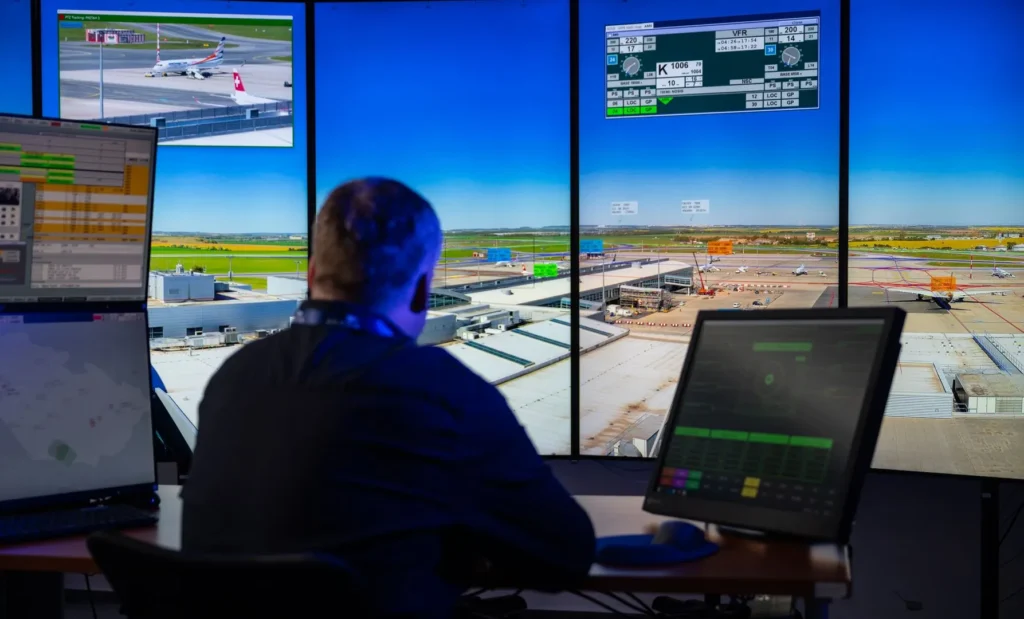
Atrak, part of the industrial and technology group CSG, unveiled its latest air traffic management solution – MAESTRO Digital Remote Tower – at Airspace World in Lisbon. The advanced platform combines high-performance cameras, sensor technology and artificial intelligence tools, providing air traffic controllers with a level of situational awareness comparable to that of a conventional airport control tower – and in certain scenarios even more advanced.
The new platform enables air traffic control services to be managed from a centralized remote tower center, with the ability to oversee one or multiple airports simultaneously. In this way, MAESTRO offers a modern digital alternative to traditional airport control towers and introduces a more flexible approach to organizing air traffic operations.
A modern solution for more efficient airport management
MAESTRO Digital Remote Tower has been designed as an integrated system that connects high-resolution cameras, sensors, radar data and automation software within one operational environment. This allows controllers to monitor aircraft and vehicle movements on runways, taxiways and aprons in real time, as well as activity in the surrounding airspace, without needing to be physically located in an airport tower.
The company describes MAESTRO as an important step forward in the development of its air traffic control and airspace management portfolio. The system builds on CSG’s extensive experience in radar systems, ATM software and operational technologies developed for both civil and military clients around the world.
A digital alternative to conventional airport towers
In recent years, the aviation industry has been facing increasing demands related to safety, operational efficiency and the availability of qualified personnel. At the same time, building and maintaining traditional airport towers has become increasingly expensive and operationally demanding.
MAESTRO addresses these challenges by enabling centralized management from a single operational center while reducing infrastructure costs and enhancing decision-making through advanced data support. One of the platform’s key advantages is its ability to manage multiple airports from one location, offering greater flexibility and optimizing available resources.
The system uses panoramic high-resolution cameras with optical zoom, alongside infrared and thermal imaging capabilities, ensuring reliable monitoring during night operations and in reduced-visibility conditions. Visual data is integrated with radar and ATM systems to create a real-time digital overview of the entire operational environment.
Artificial intelligence supporting decision-making
One of MAESTRO’s standout features is the integration of artificial intelligence into day-to-day air traffic control operations. The platform supports automatic object detection and tracking, fusion of optical and radar data, early identification of potentially hazardous situations, and transcription of communication between pilots and air traffic controllers.
These capabilities help detect emergencies, communication irregularities and possible surface movement conflicts at an earlier stage, further improving operational safety and efficiency.
The solution is primarily intended for regional and mid-sized airports, air navigation service providers, military and civil airport operators, as well as government institutions responsible for airspace management and oversight.
Tested in real operational conditions at Prague Airport
MAESTRO has been undergoing development and live operational testing for more than 18 months at Vaclav Havel Airport Prague in Prague. During this period, the system has been connected to live operational data, communication networks and airport surveillance infrastructure.
This environment has enabled extensive testing of ATM integration in real traffic conditions, AI-assisted monitoring, and operations during different weather conditions, night-time activity and emergency scenarios.
Prague Airport has also provided valuable operational data that has helped fine-tune the system under heavy traffic conditions and across a wide range of operational requirements. Development in such a live airport environment represents a significant competitive advantage for Atrak and CSG, as it ensures the platform is shaped by practical experience from real-world operations.
The MAESTRO platform is a natural continuation of CSG’s long-standing expertise in radar systems, surveillance technologies and airspace management solutions, which are currently deployed across markets in Europe, Asia, Africa and other regions worldwide.
Source: https://www.nedeljnik.rs/atrak-predstavio-digitalni-daljinski-toranj-nove-generacije-za-kontrolu-vazdusnog-saobracaja/